The Path to the River
Bates College safety concerns become real when you examine what's actually around the campus. Picture a runner. She's a Bates student, a sophomore from Connecticut, and it's the kind of September evening that sold her parents on the place — gold light, the air finally cool. She takes the route down toward the Androscoggin because someone told her it was beautiful, and it is. Earbuds in. Phone on her arm. She has no reason to think the path to the river is anything other than what the campus tour implied it was.
I want to be clear about what that paragraph is: a story. She isn't real. I made her up to show you something, the way you'd run a fire drill before there's a fire. But every street she's about to pass through is real, every number I'm going to attach to those streets is on the record, and the only invented thing in what follows is her — which is the point. The college is selling her parents a version of this walk. I'm going to walk it honestly.
The real threat is duller than a stranger in the bushes and it is worse, because it isn't one man you could see coming.
Start at the door handle of the convenience store on the corner. It's the smallest piece in the whole machine and it tells you the most. Imagine you reach for it right after a certain kind of man lets go of it — and you've already read him before you decided to, because it arrives all at once, the way a smell hits before you've named it. The fingernails packed black to the quick. One eye gone red, the other not. The jaw moving on nothing, grinding a thought that has no words left in it.
That man is a composite — I'm not pointing at anyone — but anyone who has stood on that corner knows the read is true. Now run it down every corner near this campus, at every dusk, and you have the actual texture of the place, the one the glossy folder is engineered to delete.
The Real Environment Around Campus
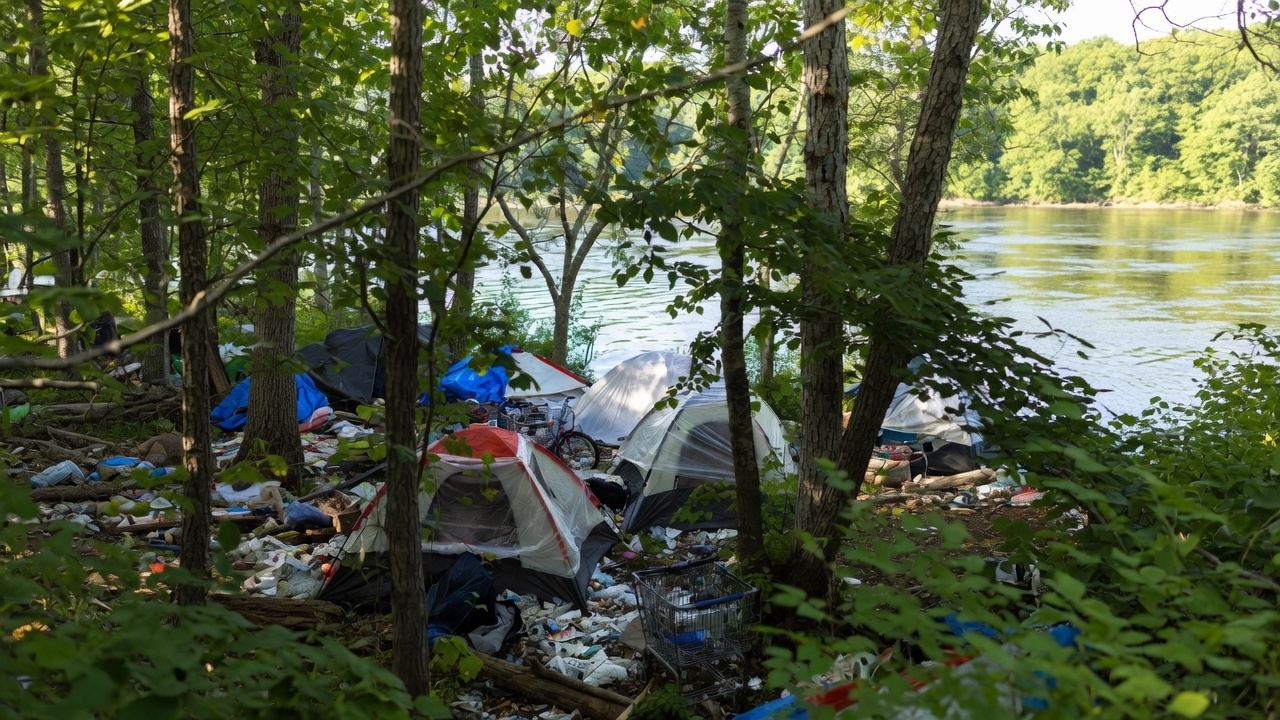
This is not the cheap fear, the one where a homeless man comes out of the brush at your child. The people in the riverside camps are a danger to themselves long before they are a danger to anyone running past. They're sick. Addiction is a sickness, whatever you believe about how a man first walks into it. The real threat is duller than a stranger in the bushes and it is worse, because it isn't one man you could see coming. It's the whole environment, and you can't outrun an environment.
And it was never only the addicts — that's the trick of it. Point everyone at the needle and they get to not see the rest of the street. So picture the rest of the street, the way down to the river. The porch with the pit bulls behind cheap wood lattice, hurling themselves against the slats and pawing the gaps as our runner passes — not a loose-dog problem, a household telling the street exactly who it is and what it keeps.
The teenage boys in the park working out among themselves who's the baddest, which at that age in that place is not a schoolyard question, and the ones who win that contest are the ones the system finally introduces itself to a few years later, too late to mean anything. Needles in the same grass the splash-pad kids run across in July. The car that treats a stop sign as a rumor it heard once.
And somewhere in that walk, the kind of thing that does happen here: a blade coming out over something that started as nothing — the particular silence that falls when everyone on a block does the math at the same time and decides not to be the next variable in it. A door kicked in three streets over, an older resident shoved to her own floor inside the house she's kept for decades.
I'm not telling you these exact things happened to our invented runner on an invented evening. I'm telling you they happen, on these streets, to real people, and that the route to the river runs straight through the ground where they happen.
The Machine That Keeps Problems Cycling
Lay the apparatus on the bench and look at how it's actually built, because once you see the load path you can't stop seeing it. The Androscoggin County Jail is rated for 160 beds. It holds north of 200 — 216 the day the sheriffs put it in writing. The county projects $700,000 in 2026 just to board the overflow in other counties, and carries a
In October 2025 the sheriffs of Androscoggin, Franklin and Oxford went in together to ask for a single shared jail — not out of ambition, but because not one of them has a place left to put a human being. That is the load-bearing member of the whole structure, and it is already cracked straight through.
Watch what happens the instant it gives. No bed means no consequence. A man picked up for a low-level offense gets what the old guys call a hot and a cot — a meal, a night inside, maybe two — and he's back on the street by Saturday, because the only alternative is a bed that does not exist. The officer who books him knows he'll book the same man again on Tuesday.
There's a particular deadness in a man's hands when he's running a bolt into a thread he can already feel is stripped, knowing it will not hold, torquing it down anyway because the procedure says to. That is not a cop gone soft. That is a man bolted into a machine that was built — whether anyone meant to build it this way or not — to do nothing, slowly, at great expense.
Overcrowded Jail System
County jail holds 216 inmates in 160-bed facility, creating revolving door with no consequences for repeat offenders.
Crime Concentration
Over 80% of Lewiston's 114 shootings from 2022-2024 occurred in streets surrounding Bates campus.
Incomplete Solutions
City provides clean needles but lacks treatment capacity, creating permanent encampments without recovery paths.
Half-Finished Public Health Policy
Layer the public-health side on top of it, and stay with the other view honestly, because it deserves better than a strawman. In 2022, Maine adopted rules permitting what's called a 100-to-1 model for syringe programs: turn in a single used needle, walk out with as many as a hundred clean ones, and the state allows you to receive them whether or not you bring any back. In the spring of 2025, the Legislature was asked, in a bill called LD 219, to restore the older one-for-one limit, and it declined.
The people who built that policy are not monsters and they are not fools, and the honest piece says so plainly. The medical consensus — the American Medical Association included — holds that clean needles reduce the spread of HIV and hepatitis C. Maine's own CDC director testified against LD 219 on exactly those grounds, and physicians pointed to a real HIV outbreak among the unhoused in the Bangor area as evidence of what happens without access.
But a policy is a sentence, and this city only wrote the first half of it. We built an elaborate, well-funded apparatus to make the needle safer and spent comparatively nothing on the part where an actual human being gets pulled out of the hole and given somewhere to go. What stands on the riverbank is not managed recovery. It's a permanent, deteriorating settlement, and the proof that the back half of the sentence was never written is that the settlement is still there, larger every year. We perfected the clause about the syringe and never wrote the clause about the person.
The Crime Map Nobody Wanted to Draw
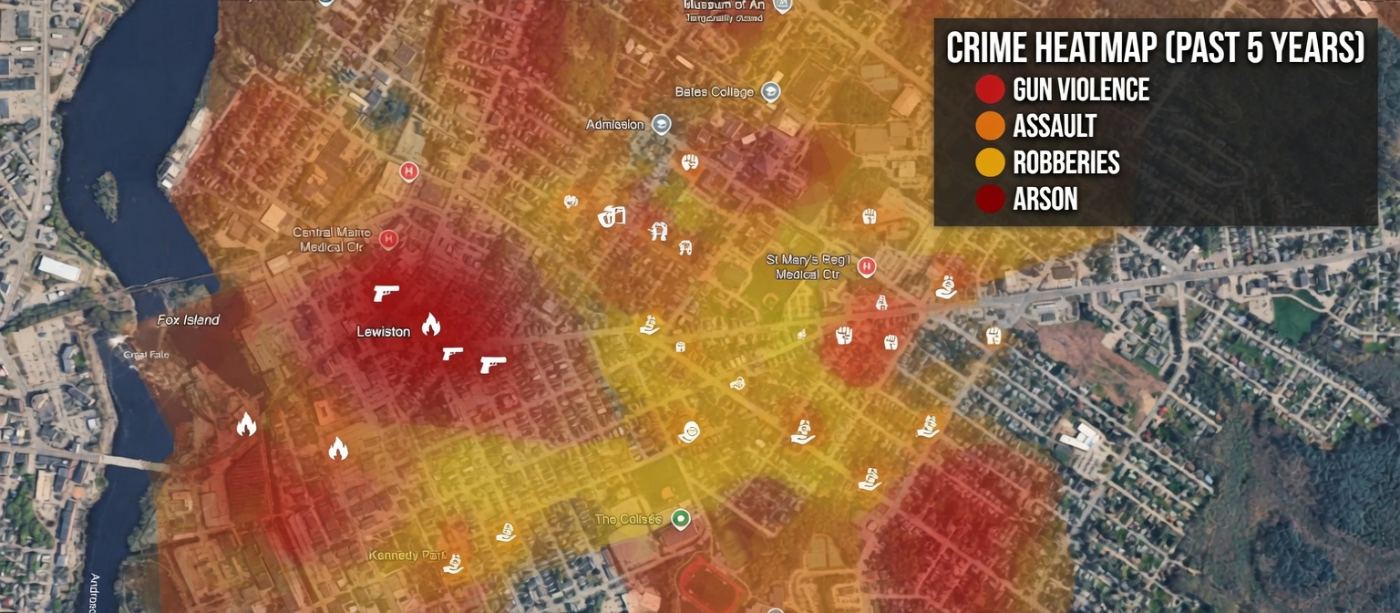
Here is where you should put the coffee down, because you don't have to take my word for any of it. The city counted it itself and didn't notice what it had drawn. From 2022 through 2024, Lewiston logged 114 shootings, and more than eighty percent of them — ninety-five — clustered into the streets between Russell Street, the Androscoggin, and Mike McGraw Park, the ground that rings this campus. Pierce Street alone took twelve. Knox Street, nine. College Street — the street Bates put its name on — three.
Confirmed shootings citywide ran 42 in 2022, 38 in 2023, 35 in 2024, on a trend that began climbing around 2018, when the decade before had mostly seen fewer than ten a year. Layer in the overdoses, the dealing, the break-ins, and the shootings stop reading like outliers and start reading like the temperature. The Sun Journal put it plainly: shootings have become part of the backdrop of the city.
The city did not sit down to draw a map of where its own order had quietly failed. It drew one anyway, in incident reports, one address at a time, and the shape those reports make on the page is the same ground a student crosses to reach the water — convinced the river is the whole picture, because that is what she paid for and what she was promised.
Lessons From October 25th, 2023
There's a thread tying all of it together, and it has to be handled carefully, because it would be easy and dishonest to abuse it. On October 25th, 2023, eighteen people were murdered in this city. I am not going to fold that night into an argument about drug camps, because it does not belong there — that was a mentally ill man with a rifle, and anyone who blurs those two things to score a point is lying to you.
But read the investigations, because they reveal the same disease I've been describing, in its most catastrophic form. The man who did it was on everyone's radar for months. His own family warned the police. The Army barred him from weapons on duty. A fellow reservist texted a superior, in plain words, that the man was going to "snap and do a mass shooting."
The independent commission Governor Mills convened found, unanimously, that the Sagadahoc County Sheriff's Office had probable cause to take his guns under the state's yellow flag law weeks before the attack — and called the decision to leave it to his family an abdication of law enforcement's responsibility.
And here is the tell, the part that should close the argument: the system could act, eventually. The yellow flag law was used about eighty times in the three years before Lewiston. In the five months after, it was used more than a hundred and thirty. Two years on, Maine voters passed a stronger red flag law outright. The capacity was always there. What was missing, every time, was the will to use it before the bodies, not after.
That is the through-line. Not drugs. Not homelessness. A system that can see the danger coming and defers the intervention until the intervention is a body count. The massacre was that failure at its worst. The revolving-door jail and the encampment near a student's running route are that same failure in its chronic, daily, grinding form. The same disease, running a different fever.
What Bates Can Actually Do
So when the college sends the reassuring email, be precise about what is being promised. It is promising to manage the symptom along its own perimeter, with a security force and a good working relationship with the police. It is not promising to repair the machine, because a college cannot manufacture jail beds the county can't afford or cast a vote in the legislature.
But there is a great deal a school that size can do, and it is the reason I'm writing this down. It can stop selling the immediate neighborhood as a moat. It can tell the young woman from Connecticut the truth about the river path instead of letting the path teach her itself. And it can put real institutional weight — and a school with that endowment, sitting on land it pays no property tax on while the rest of us cover the difference, has enormous weight — behind the unglamorous back half of every sentence this city has left unfinished: the beds, the treatment, the place for a human being to actually go.
A college that can fund a security team, a police liaison, and a marketing office to keep all of this out of the brochure can fund a phone call to the county commission. It can send someone to a council meeting. It can spend one ounce of that reputation it guards so carefully leaning on the people who actually hold the levers.
I don't write this because I hate my city, or the college. I write it because I've lived here my whole life, and I am worn through from watching everyone with the power to change something agree, very politely, to manage it instead — right up until the morning it cannot be managed anymore. We've already had that morning once. Enough.
Loading comments...